Comparison
Electric or Stovetop Pressure Canner? An Honest Comparison
For most home canners our main pick is a stovetop pressure canner. The National Center for Home Food Preservation says its advice was written for stovetop canners that hold four or more quart jars upright. An electric canner does the watching and venting for you. But nobody outside the company has published test results on it.
Disclosure: This page contains affiliate links (marked with *). If you buy through them, we earn a small commission at no extra cost to you. As an Amazon Associate I earn from qualifying purchases. Learn more
The short answer
Choose stovetop if you can stay near the stove and want the type the canning experts wrote their advice for. Consider a plug-in canner if your stove is a poor fit or you want the steps automated, and you accept that its maker's testing is unpublished. The experts don't all agree about electric canners, and we give no verdict of our own.
What's on this page
- How do they compare side by side?
- Who watches the canner?
- What is venting, and who does it?
- What backs up each one?
- Does altitude matter?
- Will my stove work?
- What about lifting and moving?
- Which recipes can I use? The sources disagree for electric
- When is electric not worth it?
- When can electric make sense?
- Which one should I pick?
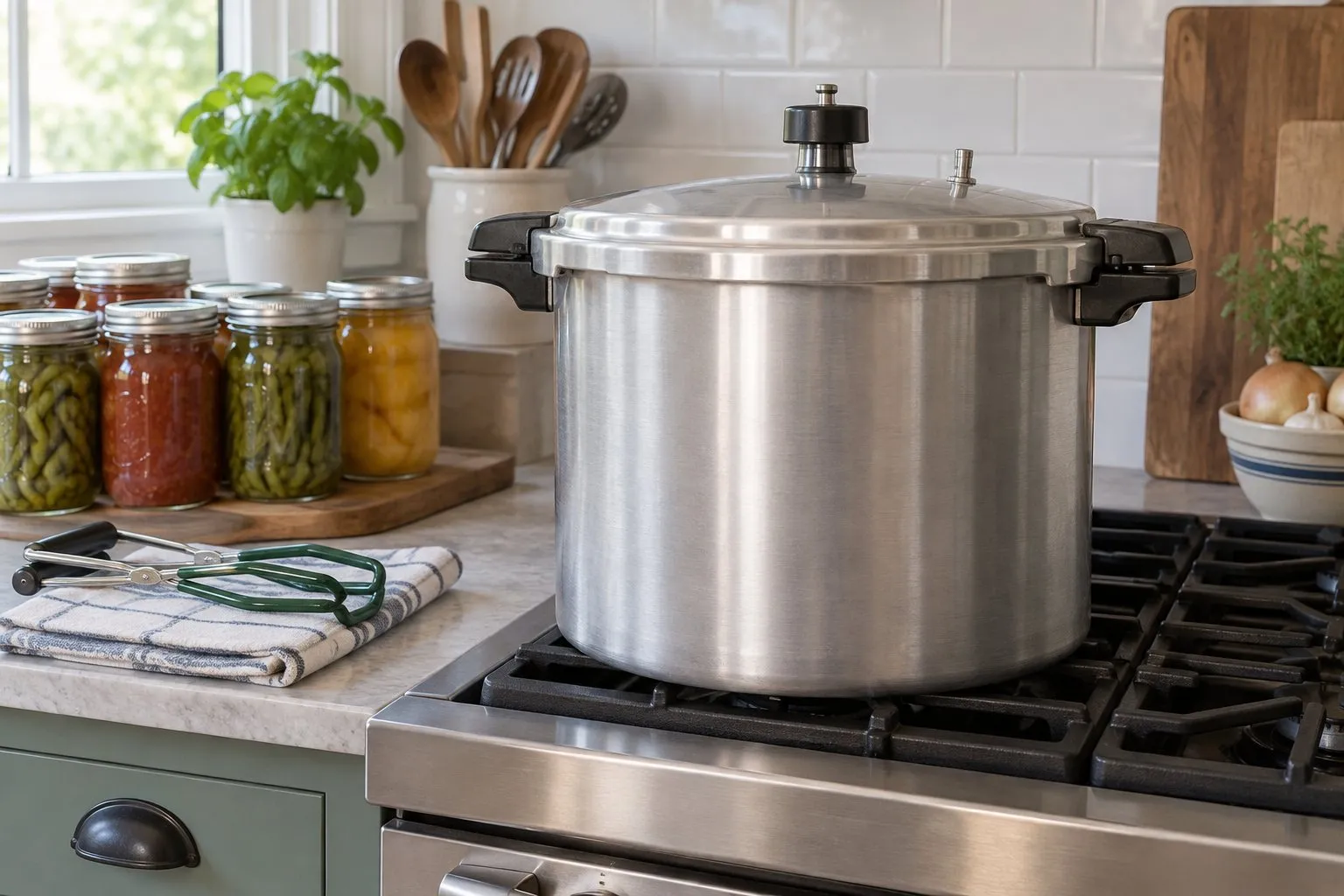
This choice is less scary than the forums make it sound. Both routes start with a tested recipe and a manual you've actually read. The differences are about who does the watching, and what has and hasn't been published.
"Electric" here means a plug-in canner made just for canning, such as the Presto Precise. A multi-cooker is different. The National Center for Home Food Preservation does not support USDA canning instructions in one. See canning in an Instant Pot. How we compare explains our method.
How do they compare side by side?
| Stovetop (Presto 01781) | Electric (Presto Precise 23-Quart) | |
|---|---|---|
| Expert advice | Written for this type | Kansas State says Presto's claims can't be checked |
| Heat | Your stove | Its own heater, plugged in |
| Control | Dial or weighted gauge, and you adjust the burner | Temperature sensor, per Presto |
| Venting | You do it, following the manual | Automatic, per Presto |
| Gauge check | Dial gauges need a yearly accuracy check | Never needs calibration, per Presto. Nobody outside the company has confirmed that |
| Altitude | You raise the pressure using the USDA tables | No adjustment needed when pressure canning, per Presto. Not confirmed outside the company |
| Quart jars | Seven, per Presto | Seven, per Presto (five on the 12-quart and 17-quart) |
| Price | Mid-range | Premium |
For water bath canning, the time changes with altitude on both.
Who watches the canner?
On a stovetop canner, you do. You adjust the heat to hold the pressure the recipe calls for. The National Center says losing pressure at any time can leave food under-processed. If that happens, its guide says to bring the canner back to pressure and start the timing over.
Presto says its electric canner holds the temperature by itself. It stops with an error code if the temperature falls below 240°F. Your manual tells you what to do after that code.
What is venting, and who does it?
Venting means letting steam push the air out of the canner before it closes up. The National Center says trapped air lowers the temperature at a given pressure. On a stovetop canner, you do this step. Presto says its electric canner vents automatically.
Even if you go electric, it helps to learn this step. The National Center's guide to using pressure canners explains it in plain language.
What backs up each one?
The National Center says its advice was written for stovetop canners that hold four or more quart jars upright. That is the plainest reason for our main pick.
Presto says it has done extensive testing of its electric canner. Kansas State says the type and amount of that research isn't available. Penn State says the National Center can't check the company's statements.
The USDA and the National Center don't approve any canner, so "approved" is not a difference between the two.
The experts don't all agree about electric canners:
- The University of New Hampshire recommends stovetop canners only. It wrote that before Presto's machine existed.
- Kansas State says you have to trust the maker.
- North Dakota State treats the Presto as a usable option.
We don't settle it. What the National Center says has the details, and are electric pressure canners safe has the rest.
Does altitude matter?
Yes, and it's a real difference in how you work. Stovetop users read the USDA tables for their altitude. Presto says its sensor makes that unnecessary when pressure canning, because the machine holds the temperature at any altitude. Nobody outside the company has published data to confirm it. Our altitude page compares each type and links the official tables.
Will my stove work?
Presto lists the 01781 for gas and for electric coil and smooth-top ranges. It says its 01784 also works on induction.
Penn State warns that some smooth-top stoves may crack under a canner's weight. Others may cycle the heat on and off so the temperature drops. It also says makers advise against portable burners. Check your stove's manual, and see canning on a glass-top stove. If your stove is ruled out, that is one honest reason to look at electric.
What about lifting and moving?
Presto says its electric canner stays in place once plugged in, and you add and remove water and jars. A loaded stovetop pot stays on the burner until it has cooled, and the National Center says that is fine. If lifting is hard for you, plan your setup before you choose.
Which recipes can I use? The sources disagree for electric
Presto says tested stovetop recipes work in its machines. Kansas State and Penn State say to follow only the manual. Kansas State's reason is that the manual leaves out at least two special USDA instructions. North Dakota State says to use tested recipes from the National Center or your state's university extension office (free local food-safety advice).
We don't pick a side. Read your current manual and ask Presto.
When is electric not worth it?
- You have a suitable stove and can stay nearby. You'd pay more for automation. The mid-range stovetop pot holds the same seven quart jars by Presto's chart.
- The open questions would worry you. A canner should leave you feeling settled about your pantry. If trusting the maker's unpublished testing doesn't sit well, stovetop is a good answer.
- You mostly can fruit, jams and pickles. You may not need pressure at all. See electric water bath canners.
When can electric make sense?
- Your stove's manual rules it out, or you have no stove to spare.
- You want venting and temperature holding done for you, and you've read what Kansas State and Penn State say.
- You want to can on a counter or table near an outlet. Presto names that as an advantage.
Which one should I pick?
Which one, then?
If you can stay near the stove and want the type the canning experts wrote their advice for → Presto 23-Quart Stovetop (01781)
View(paid link to Amazon, opens in a new tab)Ad · paid link · check price & delivery on AmazonIf you pressure can quarts and don't need water bath quarts in the same pot → Presto 16-Quart Stovetop (01755)
View(paid link to Amazon, opens in a new tab)Ad · paid link · check price & delivery on AmazonIf you want electric and the most jars → Presto Precise 23-Quart (02153)
View(paid link to Amazon, opens in a new tab)Ad · paid link · check price & delivery on AmazonIf you want electric, in the smallest Presto Precise size → Presto Precise 12-Quart (02144)
View(paid link to Amazon, opens in a new tab)Ad · paid link · check price & delivery on AmazonIf you want to see every electric size first
Presto
Presto 23-Quart Stovetop (01781)
A pot for your stove, the kind the USDA's canning steps were written for.
- Type
- Stovetop pressure canner with dial gauge
- Pressure canning
- Yes
- Water bath
- Yes, quarts and smaller, per Presto
- Liquid capacity
- 23 quarts
- Jars per load
- 7 quarts, or 20 regular-mouth pints stacked
- Altitude
- You raise the pressure by altitude from the USDA tables. Water bath times also change with altitude.
- Price class
- Mid-range
Stated in: Presto Canner Comparison Guide (2025), read 2 November 2026
Why here: Our main pick: a stovetop canner with a dial gauge, seven quart jars by Presto's chart, and the type the canning experts wrote their advice for.
Best for: You want to pressure can low-acid foods (vegetables, meat, chicken, fish) and can stay near the stove.
- The National Center's advice was written for stovetop canners
- Seven quart jars, or up to 20 regular-mouth pints stacked, says Presto
- Also works as a water bath canner for quarts and smaller, says Presto
- Works on gas and on electric coil and smooth-top ranges, says Presto
- You watch the gauge and adjust the heat yourself
- The dial gauge needs an accuracy test every year, says Presto
- Presto does not list induction for this pot. The 01784 is its induction version
Still unsure about buying at all? Read are pressure canners worth it. If you lean stovetop, see our stovetop canner page. If you lean electric, the electric short list compares all sizes.
What people ask
Is a stovetop or an electric pressure canner better for a beginner?
The sources don't name a winner. Presto says its electric canner vents and holds the temperature by itself, so there are fewer steps. A stovetop canner asks you to learn those steps, and the National Center for Home Food Preservation has a step-by-step guide. We pick stovetop first because the experts wrote their advice for that type. We respect the other choice.
What is the easiest pressure canner to use?
A plug-in canner made just for canning asks the least of you, per Presto. It warms the jars, vents and holds the temperature by itself. But easy to run is not the same as proven. Nobody outside the company has published test results. A multi-cooker is not an easier canner, because the National Center does not support USDA canning instructions in one.
Do I still need a tested recipe with an electric canner?
Yes, and the sources disagree on which one. Presto says tested stovetop recipes work. Kansas State and Penn State say to follow only the manual. North Dakota State says to use tested recipes from the National Center or your state's university extension office (free local food-safety advice). Read your current manual and ask Presto.
Does a stovetop canner work on a glass or induction range?
It depends on the range and the pot. Presto lists the 01781 for gas and for electric coil and smooth-top ranges, and its 01784 for induction too. Penn State warns that some smooth-top stoves may crack under a canner's weight. Others may switch the heat on and off, and the temperature can drop. Your stove's manual decides.
Is an electric pressure canner worth it?
If you have a suitable stove and can stay with the canner, often not. It costs more, and Presto's chart shows it holds no more quart jars than a mid-range stovetop pot. It can make sense if your stove is a poor fit or automatic steps matter to you, as long as you're comfortable with the open questions.
Where this comes from
- NCHFP: Canning in electric multi-cookers (February 1, 2019)
- NCHFP: Preserving Food, Using Pressure Canners
- Presto: Precise Digital Pressure Canners, Facts and FAQ (2025)
- Presto: Canner Comparison Guide (2025)
- Penn State Extension: Buying a pressure canner (April 21, 2026)
- K-State Research and Extension: Presto digital pressure canner (March 17, 2021)
More from the shelf
- Buying guideStovetop cannersA stovetop pressure canner is the type the canning experts wrote their advice for. See dial vs weighted gauge, jar counts, stove fit and our pick.
- ComparisonBest electric cannersFour Presto Precise sizes compared by how many jars they hold and how they work, with what the experts say. We don't rank them by safety.
- BrandPresto PreciseThe Presto Precise digital pressure canner in all four sizes: jar counts, how the sensor works, what Presto claims, and what university experts say.
- ExplainerAltitudeHigh altitude canning depends on your machine: USDA tables for stovetop canners, Presto's sensor claim, NESCO's regulators and water bath changes.
- Question & answerAre Electric Pressure Canners Safe? What the Experts SayThe experts don't agree on whether electric pressure canners are safe, and nobody outside the company has published test results. Here is who says what.
Who writes here
electricpressurecanner.com Editorial Team
Machine comparisons & source reading
We are the editorial team at electricpressurecanner.com. We read manuals, spec sheets and the statements of NCHFP, USDA, CDC and Extension services, and we report who says what, with dates. No lab work happens here, and this site publishes no processing times or recipes of its own.
- Manuals and food-safety guidance read
- Sources and dates on every page
- No lab tests, stated openly
- No own processing times or recipes