Explainer
Pressure Canning at High Altitude: What Changes by Machine
Above 1,000 feet, water boils at a lower temperature, so high altitude canning has to change. How depends on your machine. Stovetop canners follow the USDA altitude tables. Presto says its sensor needs no change when pressure canning. NESCO swaps in a heavier regulator above 1,000 feet. Water bath always needs a change.
Disclosure: This page contains affiliate links (marked with *). If you buy through them, we earn a small commission at no extra cost to you. As an Amazon Associate I earn from qualifying purchases. Learn more
The short answer
Canners differ on altitude. Presto says no change is needed when pressure canning, because its sensor holds the temperature. Nobody outside the company has confirmed that. NESCO swaps in a heavier regulator above 1,000 feet and stops at 7,500 feet. Stovetop canners follow the USDA tables. Water bath always needs a change. We print no pressure table and link to the official one.
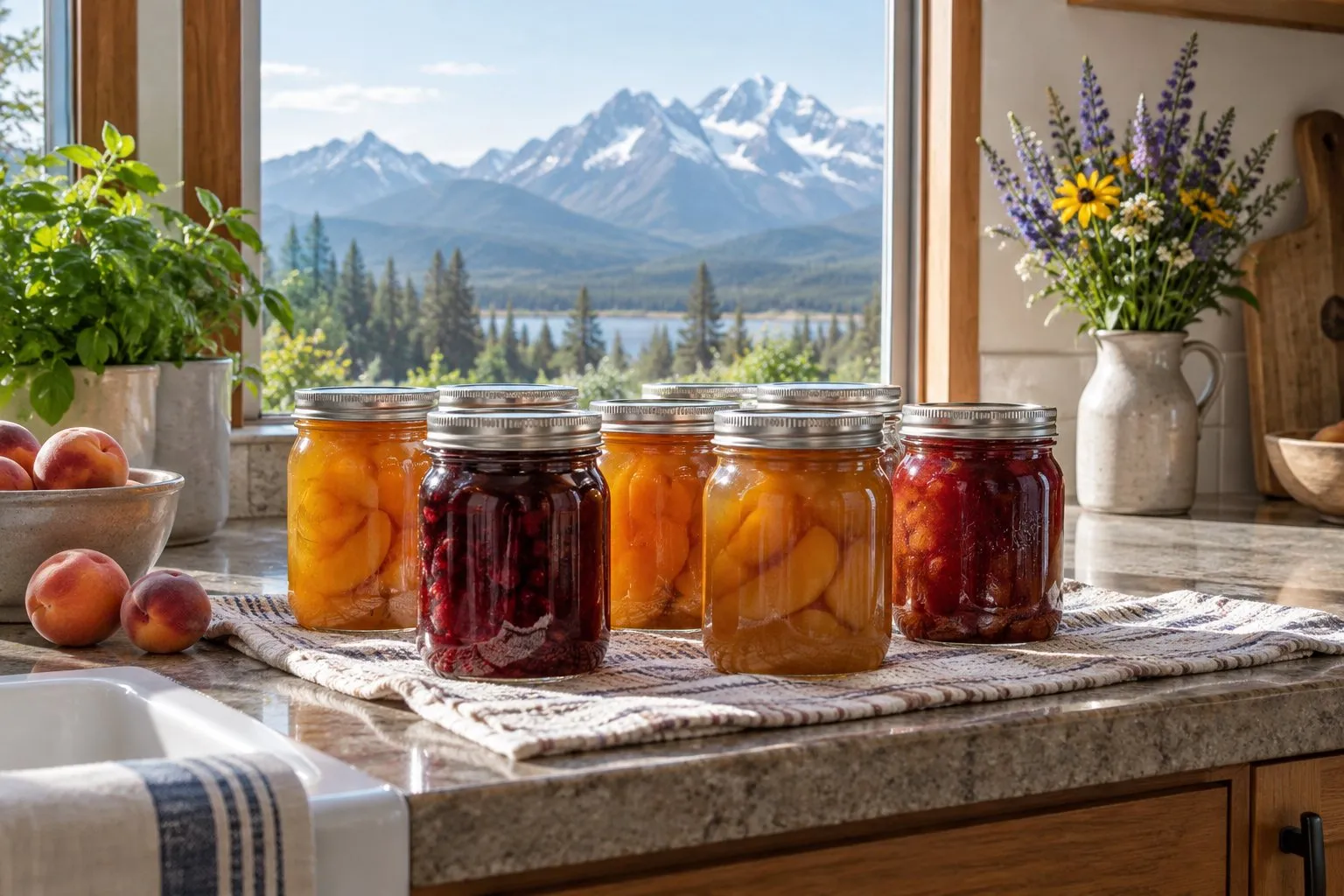
If you live up in the mountains, canning takes one extra step of care. You need to know which rule belongs to your machine. Much of the confusion online comes from using one machine's rule on another.
Why does altitude matter?
The USDA says it in one line: temperatures inside a canner are lower at higher altitudes. Water boils at a lower temperature as you climb. The National Center for Home Food Preservation (the US canning experts at the University of Georgia, "the National Center" from here on) says lower boiling temperatures are less effective at killing germs. High heat held long enough does the work. Pressure doesn't kill germs directly. It's just how a canner reaches that heat.
So the two methods fix this differently. In a pressure canner, you raise the pressure. In a boiling water canner, you add time. The National Center says sea-level times may not be enough from about 1,000 feet up. It says the wrong pressure or time for your altitude can lead to spoilage.
Who adjusts how?
These are what each maker and expert says. The rule for one type does not carry over to another.
- Stovetop canner with a dial gauge (a clock-face pressure dial): You raise the pressure using the USDA table. It has four altitude bands.
- Stovetop canner with a weighted gauge (a small weight that rocks or jiggles): You raise the pressure using the USDA table. It has two bands: at or below 1,000 feet, and above.
- Presto Precise, pressure canning: Presto says no change is needed, because the sensor holds the temperature. Nobody outside the company has confirmed that.
- Presto Precise, water bath: The time changes with altitude, says Presto.
- NESCO NPC-9 cooker-canner: Black regulator at or below 1,000 feet, green above. NESCO does not recommend use over 7,500 feet.
- Ball EasyCanner, electric water bath: Water bath always needs a change for altitude. Follow your tested recipe.
- Electric multi-cooker (Instant Pot): Not for pressure canning. The National Center says you can't use the same pressure and time at every altitude.
Where are the official tables?
We print no pressure table on this site, on purpose. A wrong number copied from a website can lead to under-heated food. These numbers already have an owner.
- The USDA tables: each food in the USDA Complete Guide has its own table by canner type and altitude. Guide 1 explains the basics.
- How to read them: the National Center's page on choosing the right processing time explains the bands.
- Your altitude: ask your local county extension agent (free local food-safety advice) if you don't know it.
Dial or weighted gauge at altitude?
Penn State says both types preserve food safely when used correctly. The difference shows up in the mountains. The National Center says weighted gauges can't adjust precisely for altitude. They step up in one jump above 1,000 feet. Penn State says dial gauges allow finer changes at high altitude. Presto's guide says the same of its dial-gauge canners above 2,000 feet. The trade-off is upkeep. The National Center says to check a dial gauge for accuracy before use each year, and many county extension offices can help.
Presto
Presto 23-Quart Stovetop (01781)
A pot for your stove, the kind the USDA's canning steps were written for.
- Type
- Stovetop pressure canner with dial gauge
- Pressure canning
- Yes
- Water bath
- Yes, quarts and smaller, per Presto
- Liquid capacity
- 23 quarts
- Jars per load
- 7 quarts, or 20 regular-mouth pints stacked
- Altitude
- You raise the pressure by altitude from the USDA tables. Water bath times also change with altitude.
- Price class
- Mid-range
Stated in: Presto Canner Comparison Guide (2025), read 2 November 2026
Why here: A stovetop canner with a dial gauge, the kind that follows the USDA tables by altitude band. It is our main pick for most readers.
Best for: You want to pressure can low-acid foods (vegetables, meat, chicken, fish) and can stay near the stove.
- The National Center's advice was written for stovetop canners
- Seven quart jars, or up to 20 regular-mouth pints stacked, says Presto
- Also works as a water bath canner for quarts and smaller, says Presto
- Works on gas and on electric coil and smooth-top ranges, says Presto
- You watch the gauge and adjust the heat yourself
- The dial gauge needs an accuracy test every year, says Presto
- Presto does not list induction for this pot. The 01784 is its induction version
For more choices, see our stovetop canner page. The gauge comparison goes through the two types.
Can you trust the sensor claim?
Presto's explanation is simple: its canner holds 240°F whether you live at 1,000 or 10,000 feet, so altitude doesn't affect the pressure method. North Dakota State describes the machine the same way, and Penn State says it adjusts for altitude. The USDA does say high heat is what kills germs. That doesn't by itself show what a machine reaches inside your jars.
What's missing is the data. Nobody outside the company has published test results for Presto Precise canners. A sensor in the canner doesn't measure inside your jars. Presto's claim also covers pressure canning only. Its own FAQ says water bath needs the altitude change in the USDA guide. More on our Presto Precise page.
What did the multi-cooker research find?
Utah State's extension service ran three electric pressure cookers it did not name, at about 2,900, 4,500 and 7,100 feet. It put temperature loggers in the jars. Many batches were under-heated, more of them at higher altitude. Results varied even for the same food, cooker and altitude. It says not to can low-acid food in such cookers.
This study covers cookers, and their models are not named. It says nothing about any canner we can name. That's why Instant Pot canning has its own page.
What should you do above 1,000 feet?
- Find your altitude before you shop, and check it against the manual of any machine you're considering.
- Read the altitude part of your manual. On a NESCO, that includes which regulator is fitted. See the NESCO page. Read are electric pressure canners safe too.
- Use the tested recipe's own altitude line. Water bath recipes have one too.
- Compare your options. Our electric vs. stovetop comparison treats altitude as one deciding point.
What people ask
I live at 5,000 feet. Can I use an electric pressure canner, and how do I adjust?
It depends on the machine, so read its manual first. Presto says no change is needed when pressure canning, but nobody outside the company has confirmed that. NESCO's guide uses its heavier regulator above 1,000 feet. Multi-cookers are not for this. Utah State found under-heated food in three cookers it did not name, more often at higher altitude.
Do electric canners adjust for altitude by themselves?
Not all of them. Presto says its digital canners do when pressure canning, and North Dakota State and Penn State describe them that way. NESCO's guide asks you to swap regulators by hand. Water bath still needs a change on any machine, says Presto's FAQ and the USDA.
Where is the official pressure canning altitude chart?
In the USDA Complete Guide to Home Canning, in the table for each food. The National Center for Home Food Preservation explains how to read them. We don't copy the numbers, so you never read an out-of-date copy.
How do I find my altitude?
The National Center says to ask your local county extension agent if you don't know it. Use the altitude of your home, not the nearest town. It says sea-level times may not be enough from about 1,000 feet up, so settle this before your first batch.
Can I use the NESCO canner above 7,500 feet?
NESCO's guide says it does not recommend that. The limit comes from the maker. Penn State says cooker-canner combos can't be recommended because research on their safety is missing. It names no brand. Putting the NPC-9 in that group is our own reading.
Where this comes from
- USDA Complete Guide to Home Canning, revised 2015, Guide 1
- NCHFP: Selecting the correct processing time
- Presto: Precise Digital Pressure Canners, Facts and FAQ (2025)
- NESCO: NPC-9 Care/Use Guide (2026 revision)
- NDSU Extension: Pressure Can It Right! FN2064 (revised August 2026)
- Utah State University Extension: Why electric pressure cookers are not pressure canners (February 2020)
More from the shelf
- ComparisonElectric vs stovetopElectric or stovetop pressure canner? See how they differ on heat, venting, gauges, altitude and jars, what the experts say, and when electric isn't worth it.
- Buying guideStovetop cannersA stovetop pressure canner is the type the canning experts wrote their advice for. See dial vs weighted gauge, jar counts, stove fit and our pick.
- BrandPresto PreciseThe Presto Precise digital pressure canner in all four sizes: jar counts, how the sensor works, what Presto claims, and what university experts say.
- BrandNESCO Smart CannerThe NESCO NPC-9 is a 9.5-quart cooker and canner in one. What its guide says, what Penn State and the National Center say about this type, and what we can't confirm.
- Question & answerAre Electric Pressure Canners Safe? What the Experts SayThe experts don't agree on whether electric pressure canners are safe, and nobody outside the company has published test results. Here is who says what.
Who writes here
electricpressurecanner.com Editorial Team
Machine comparisons & source reading
We are the editorial team at electricpressurecanner.com. We read manuals, spec sheets and the statements of NCHFP, USDA, CDC and Extension services, and we report who says what, with dates. No lab work happens here, and this site publishes no processing times or recipes of its own.
- Manuals and food-safety guidance read
- Sources and dates on every page
- No lab tests, stated openly
- No own processing times or recipes