Buying guide
Stovetop Pressure Canners: Which One to Pick
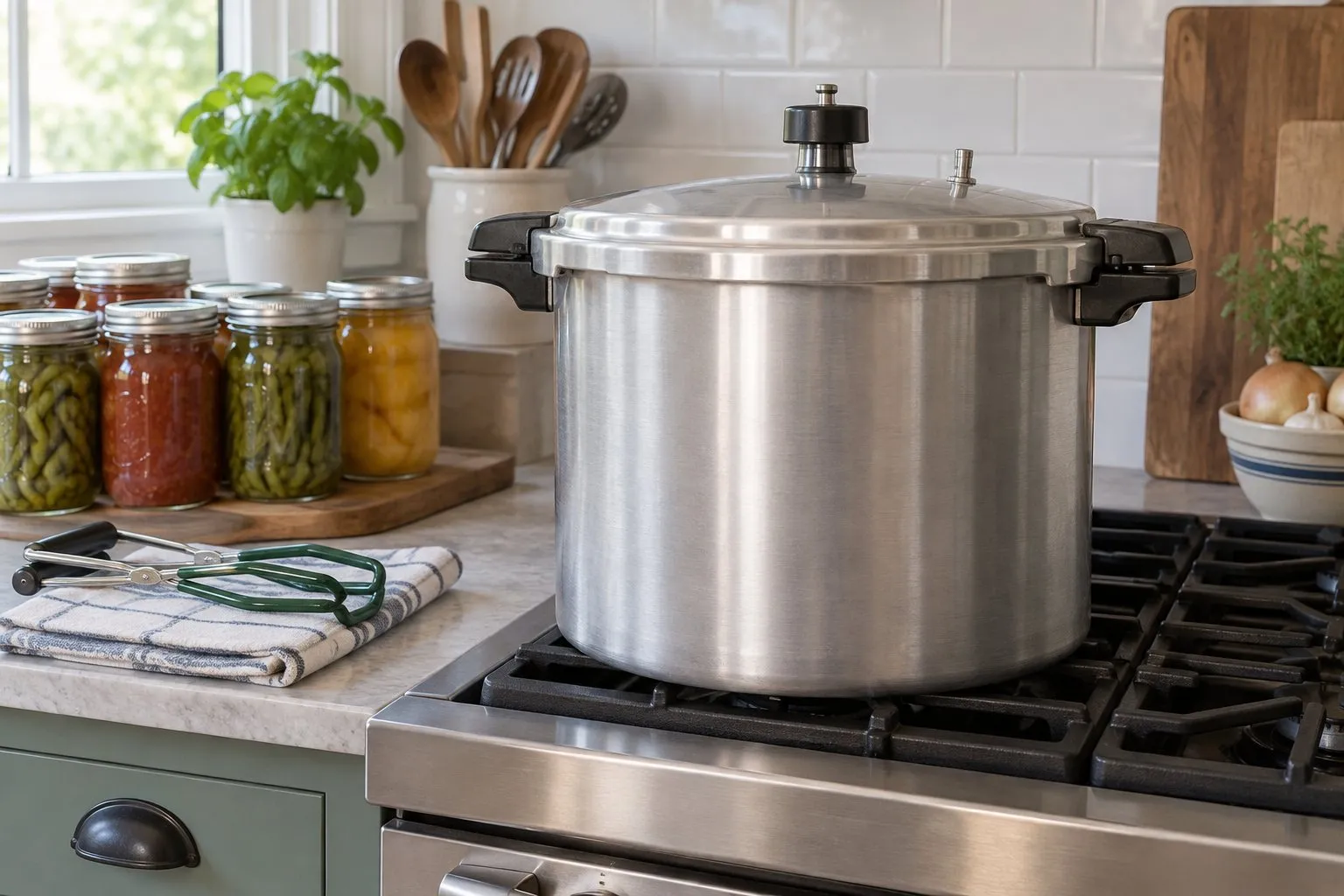
A pressure canner is a heavy pot with a locking lid, a vent and a gauge. It heats jars hotter than boiling water can. Stovetop models are the type the National Center for Home Food Preservation says its advice was written for. Our pick is the Presto 01781, a 23-quart canner with a dial gauge.
Disclosure: This page contains affiliate links (marked with *). If you buy through them, we earn a small commission at no extra cost to you. As an Amazon Associate I earn from qualifying purchases. Learn more
The short answer
To pressure can low-acid foods (vegetables, meat, chicken, fish), start with a stovetop canner. The National Center for Home Food Preservation says its advice was written for stovetop canners that hold four or more quart jars upright. Our pick is the Presto 01781. Presto says it holds 7 quart jars, and it's mid-range in price. For an induction stove, Presto's 01784 has a stainless-clad base.
A pressure canner can look like a lot at first, with its gauge, its lid and its list of steps. Take it one step at a time, with your manual and a tested recipe beside you. This is the type of machine that lets you can low-acid food from the garden.
Why start with a stovetop canner?
The USDA says low-acid foods (vegetables, meat, chicken, fish) must be canned in a pressure canner. It says heat is what kills the germs, and pressure canners reach the heat needed. The National Center for Home Food Preservation (the US canning experts) says its advice was written for stovetop canners that hold four or more quart jars upright.
That is the whole case. The stovetop canner is the machine those instructions were worked out for. It also usually costs less than a plug-in canner made just for canning. In return, you do more of the watching. The electric vs. stovetop comparison weighs that trade-off. Are electric pressure canners safe explains what is still open on the electric side.
None of this is a promise. Penn State says dial and weighted models work equally well and keep food safe when used correctly. "Used correctly" matters a lot in that sentence.
What is our pick?
Presto
Presto 23-Quart Stovetop (01781)
A pot for your stove, the kind the USDA's canning steps were written for.
- Type
- Stovetop pressure canner with dial gauge
- Pressure canning
- Yes
- Water bath
- Yes, quarts and smaller, per Presto
- Liquid capacity
- 23 quarts
- Jars per load
- 7 quarts, or 20 regular-mouth pints stacked
- Altitude
- You raise the pressure by altitude from the USDA tables. Water bath times also change with altitude.
- Price class
- Mid-range
Stated in: Presto Canner Comparison Guide (2025), read 2 November 2026
Why here: Presto says it holds 7 quart jars and also works as a water bath canner for quarts and smaller. Its dial gauge allows small pressure steps at altitude.
Best for: You want to pressure can low-acid foods (vegetables, meat, chicken, fish) and can stay near the stove.
- The National Center's advice was written for stovetop canners
- Seven quart jars, or up to 20 regular-mouth pints stacked, says Presto
- Also works as a water bath canner for quarts and smaller, says Presto
- Works on gas and on electric coil and smooth-top ranges, says Presto
- You watch the gauge and adjust the heat yourself
- The dial gauge needs an accuracy test every year, says Presto
- Presto does not list induction for this pot. The 01784 is its induction version
Which stovetop canner is right for me?
Which one, then?
If you want both methods in one pot and room for stacked pints → Presto 23-Quart Stovetop (01781)
View(paid link to Amazon, opens in a new tab)Ad · paid link · check price & delivery on AmazonIf you cook on induction → Presto 23-Quart Induction (01784)
View(paid link to Amazon, opens in a new tab)Ad · paid link · check price & delivery on AmazonIf you want a lower pot and only water bath pints and smaller → Presto 16-Quart Stovetop (01755)
View(paid link to Amazon, opens in a new tab)Ad · paid link · check price & delivery on AmazonIf you are still deciding between stovetop and electric
If you only make jams, pickles and fruit
How do they compare?
The table shows what the makers say. How we compare explains why a maker's guide counts for more than a listing.
| Comparison | Our pick for stovetopPresto 23-Quart Stovetop (01781) | Shorter stovetop potPresto 16-Quart Stovetop (01755) | Our pick for inductionPresto 23-Quart Induction (01784) | T-fal 22-Quart | All American 921 |
|---|---|---|---|---|---|
| Type | Stovetop pressure canner with dial gauge | Stovetop pressure canner with dial gauge | Stovetop pressure canner with dial gauge and stainless-clad base | Stovetop pressure canner with operating valve and gauge | Stovetop pressure canner with metal-to-metal seal |
| Pressure canning | Yes | Yes | Yes | Yes, per T-fal | Yes, per All American |
| Water bath | Yes, quarts and smaller, per Presto | Pints and smaller only, per Presto | Yes, quarts and smaller, per Presto | Sold for it, per the listing; T-fal's manual describes water bath in a conventional pot | not stated |
| Liquid capacity | 23 quarts | 16 quarts | 23 quarts | 22 quarts | 21.5 quarts |
| Jars per load | 7 quarts, or 20 regular-mouth pints stacked | 7 quarts, or 10 regular-mouth pints | 7 quarts, or 20 regular-mouth pints stacked | 7 quarts, per T-fal; its page gives two pint counts | 7 quarts or 18 pints, per All American's sizes table |
| Altitude | You raise the pressure by altitude from the USDA tables. Water bath times also change with altitude. | You raise the pressure by altitude from the USDA tables. Water bath times also change with altitude. | You raise the pressure by altitude from the USDA tables. Water bath times also change with altitude. | not stated | not stated |
| Price class | Mid-range | Mid-range | Mid-range | Budget | Premium |
| Best for | You want to pressure can low-acid foods (vegetables, meat, chicken, fish) and can stay near the stove. | You pressure can quarts and do not need water bath quarts in the same pot. | You have an induction range. | You are on a tighter budget and will ask T-fal about your stove and its pressure settings first. It is not one of our picks. | You want a metal-to-metal seal and do not mind the weight. It is not one of our picks. |
| On Amazon(paid link to Amazon, opens in a new tab)Ad · paid link · check price & delivery on Amazon | On Amazon(paid link to Amazon, opens in a new tab)Ad · paid link · check price & delivery on Amazon | On Amazon(paid link to Amazon, opens in a new tab)Ad · paid link · check price & delivery on Amazon | On Amazon(paid link to Amazon, opens in a new tab)Ad · paid link · check price & delivery on Amazon | On Amazon(paid link to Amazon, opens in a new tab)Ad · paid link · check price & delivery on Amazon |
How many jars fit?
Pick a method and a jar size. The numbers come from what the makers publish.
Method
Jar size
| Machine | Jars per load |
|---|---|
| Presto Precise 23-Quart (02153)Purpose-built electric | 7 regular-mouth or wide-mouth |
| Presto Precise 16-Quart (02154)Purpose-built electric | 7 regular-mouth or wide-mouth |
| Presto 23-Quart Stovetop (01781)Stovetop pressure canner | 7 regular-mouth or wide-mouth |
| Presto 16-Quart Stovetop (01755)Stovetop pressure canner | 7 regular-mouth or wide-mouth |
| Presto 23-Quart Induction (01784)Stovetop pressure canner | 7 regular-mouth or wide-mouth |
| Presto Precise 17-Quart (02152)Purpose-built electric | 5 regular-mouth or wide-mouth |
| Presto Precise 12-Quart (02144)Purpose-built electric | 5 regular-mouth or wide-mouth |
| NESCO NPC-9Combination cooker-canner · read the warning first | 4 wide-mouth; NESCO asks you to dry-fit jars first |
| Ball EasyCannerElectric water bath | Not a pressure canner |
Jar counts only, as the makers state them. Processing times are left out on purpose: those come from a tested recipe and your manual.
What is each model like?
Presto 01781, 23-quart with dial gauge
Presto says it holds 7 quart jars under pressure, or up to 20 regular-mouth pints stacked in two layers. It also works as a boiling water canner for quarts and smaller. Presto lists it for gas and for electric coil and smooth-top ranges. It doesn't list induction for this pot.
You adjust the heat yourself to hold the pressure on the dial. Presto says the dial helps above 2,000 feet, where small pressure steps are needed, and that it needs a yearly test. It is mid-range in price. If you can stay near the stove, this is where we'd begin.
Presto 01755, 16-quart with dial gauge
Presto says it holds the same 7 quart jars under pressure, in a lower pot. It has its own page. It holds 10 regular-mouth pints. For water bath canning it takes pints and smaller only, because Presto says the pot isn't tall enough to cover quart jars with water. Choose it if a shorter pot suits your kitchen, and you don't need water bath quarts.
Presto 01784, 23-quart for induction
It has the same jar chart as the 01781, with a stainless steel-clad base. Presto says it works on induction, electric and gas ranges. Penn State says it is aluminum with a stainless bottom. It says the pot works on gas, electric and smooth-top ranges of 12,000 BTUs or less. Check the manuals for your stove and your canner on burner size and loaded weight. If you have an induction stove, this is our pick.
T-fal 22-quart
T-fal's page and manual say it holds 7 quart jars. It is budget-priced among these canners. The page gives two pint counts. It names gas and electric coil in one line and all cooktops, including induction, in another. Ask T-fal about both. Our page on other stovetop brands has more. It is an option, not a recommendation.
Penn State says some cheaper brands hold fewer than 7 quart jars. It also says there is no information on whether newer discount brands have been tested for low-acid foods. It names no brand, so that isn't a statement about this pot.
All American 921, 21.5-quart
All American's product page says it holds 7 quart jars, plus 18 regular-mouth or 16 wide-mouth pints. It is premium-priced. An older manual copy with no date says 19 pints, and the same page lists two weights. Go by the manual that comes with your canner. It is an option, not a recommendation.
Penn State says All American is the one canner with a metal-to-metal seal, so there's no gasket to replace, and that it is heavy. North Dakota State says this brand relies on its weight regulator for processing. Its dial is only a reference and isn't checked yearly. The All American page lists all six sizes and where the sources differ.
Weighted-gauge models
Presto also makes a 16-quart canner with a three-piece adjustable regulator, the 01745. We have no listing for it here. Presto says it suits altitudes of 1,000 feet or less, and it gives a sound when pressure is reached.
What should I check before I buy?
Dial or weighted gauge?
Our gauge comparison goes through this in full.
- Dial gauge: reads pressure in small steps. The National Center's tables use four altitude bands for it. The USDA says to check it for accuracy before use each year, because a gauge that reads high causes under-processing. The CDC says many county extension offices will check gauges.
- Weighted gauge: it rocks or jiggles at pressure, so you can hear it. The USDA says it needs no watching and no accuracy check. Its one drawback, per the USDA, is that it can't correct precisely for higher altitudes. The National Center's tables use two altitude bands for it.
Jars, not quarts
The quart number on a canner is the size of the pot. A 23-quart canner holds 7 quart jars by Presto's chart, not 23. The USDA says most canners hold seven quart jars or eight to nine pints. Small pressure canners hold four quart jars. A taller pot pays off in stacked pints and room for water bath quarts.
Your stove
Read two manuals: your stove's and the canner's. Penn State says makers advise against portable burners and some smooth-top stoves. It says induction needs a magnetic stainless steel bottom.
Altitude
Higher places need higher pressure, and where that starts depends on the gauge type. The USDA says canners must run at the higher pressures its guide lists for your altitude. We don't publish a table. The altitude page explains the differences and links to the USDA tables.
Is it a pressure cooker or a pressure canner?
Listings use these words almost interchangeably, and that causes real trouble. Some big pots are sold as both, and the Presto 01781 is one of them. Going the other way doesn't work.
The National Center says the USDA has no instructions for canning in a small pressure cooker. It says the research behind its low-acid instructions was done in pots most like today's 16-quart or larger canners. Small cookers heat up and cool down faster, and that lost heat can leave food under-processed.
Electric multi-cookers are a separate matter. Our Instant Pot page covers them.
What mistakes should I avoid?
- Skipping the vent. The USDA says all pressure canners must be vented before they're pressurized, since trapped air lowers the temperature. Your manual gives the steps.
- Rushing the cool-down. The National Center says the cooling time is part of the process that kills bacteria. Let the canner cool as your manual says.
- Using an old recipe. The CDC says to use current times and pressures, and only recipes that follow the USDA guide.
- Trusting a seal. A sealed lid doesn't show the food got the heat it needed. The botulism page has what the CDC and the National Center say.
Which canner fits my kitchen?
A few short questions about what you want to can, your stove and your batch size. The finder sorts by those facts. It doesn't rank machines by safety.
Find your canner in 3 quick questions
Question 1
What do you want to can?
Vegetables, meat, chicken and fish need a pressure canner. Jam, most fruit and pickles do not.
For most home canners who want low-acid food on the shelf, a stovetop canner is the place to start. The Presto 01781 is our pick for the reasons above. No machine replaces care or a tested recipe. If you still want a plug-in option, our guide to electric canner types shows what exists and what is known about each.
- Presto stovetopPresto's stovetop line is four models, and Presto says all four hold 7 quart jars under pressure. Choose the 23-quart 01781 for stacked pints and water bath quarts, the 16-quart 01755 if you want a lower pot, and the 01784 if you cook on induction. They are also sold as cookers, which is different from an electric multi-cooker.
- All AmericanAll American makes six stovetop canners, from the 10.5-quart 910 to the 41.5-quart 941. Its sizes table says the 915, 921 and 925 hold 7 quart jars. Penn State calls it the only canner with a metal-to-metal seal. It is a weighted canner, the dial is for reference, and it costs more than a Presto that holds the same quart jars.
- Other stovetop brandsT-fal's page says its 22-quart pot holds 7 quart jars, and it gives two answers on induction. NESCO's stovetop canners are listed at 7 quart jars and work as weighted-gauge canners. For a no-name listing, look for a maker's jar chart and manual first. Penn State says it has no information on testing of new discount brands. Our stovetop pick stays the Presto 01781.
- Weighted vs dial gaugeChoose a dial gauge if you live above 1,000 feet or want to see small changes, and accept a yearly accuracy check. Choose a weighted gauge if you want to hear the pressure and skip that check. Penn State says both work equally well when used correctly. A heat sensor is a third way, and its accuracy rests on the maker's word.
- Best stovetop cannersThe Presto 01781 is our pick for most home canners. Presto says it holds 7 quart jars in pressure and water bath canning, and it is mid-range in price. Choose the Presto 01784 for induction, or the lower 01755 if you don't need water bath quarts. T-fal and All American say 7 quart jars for the pots here, on their own pages. We recommend neither.
- Pressure canner sizesBuy 23 quarts if you can stacked pints or want water bath quarts in the same pot. Buy 16 quarts if you only pressure can quarts or need a lower pot, since Presto says both hold 7 quart jars. Don't go below a canner that holds four quart jars upright with the lid on, because the USDA has no instructions for canning in smaller pressure cookers.
- How to use a cannerCheck the canner, add the rack and water as your source says, load filled jars upright, lock the lid and let steam flow freely to push the air out. Then close the vent, reach the pressure your tested recipe gives for your altitude, and hold it for the full time. Turn off the heat and let it lose pressure by itself before opening.
- Induction cannersFor an induction range, our pick is the Presto 01784. It is a 23-quart canner with a stainless steel-clad base that holds 7 quart jars, says Presto. Presto says its standard aluminum canners do not work on induction. Check your range's weight limit first, since a full canner can pass 50 pounds. Use the burner that best matches the base.
- Canner partsIf steam leaks around the lid or the canner will not build pressure, check the gasket first. Presto says to replace the sealing ring and overpressure plug at least every three years. Replace them sooner if they turn hard, misshapen, cracked, worn or pitted. Order by the model number stamped on your canner. All American canners seal metal to metal and have no such gasket.
- What is a pressure cannerA pressure canner is a large pot that traps steam so jars reach temperatures boiling water can't. The USDA lists these parts: a jar rack, a gasket, a dial or weighted gauge, a vent and cover lock, a vent port and a safety fuse. For USDA instructions, Penn State says it must hold four quart jars upright with the lid on, let air out, and show it stays at pressure.
- Is a Used or Vintage Pressure Canner Worth Buying? What to CheckIt can work, after a careful check. The University of Maine says not to use a canner with a warped bottom, deep pitting, cracks, a damaged rim or missing parts. It says to replace the sealing ring and overpressure plug either way. The National Center for Home Food Preservation warns a secondhand canner may not be a bargain. Check your pot, then ask your extension office.
What people ask
What is the difference between a pressure canner and a pressure cooker?
Size and proof. The National Center for Home Food Preservation says a pressure canner must hold at least four quart jars upright with the lid on, allow venting, and show it stays at the right pressure the whole time. The USDA has no instructions for canning in small cookers. Some large pots are sold as both.
Which is better, a dial gauge or a weighted gauge?
Penn State says both work equally well when used correctly. A dial reads in small steps, which helps at altitude, and needs a yearly accuracy check. A weighted gauge makes a sound you can hear and needs no check. The USDA says it can't correct as precisely for higher altitudes.
What size pressure canner do I need?
The USDA says most hold seven quart jars or eight to nine pints. Small ones hold four quart jars. Presto says both its 16-quart and 23-quart stovetop pots hold 7 quart jars. The taller pot adds stacked pints and water bath quarts, so choose by what you can most.
Can I use a pressure canner on a glass-top or induction stove?
It depends on your stove and your canner. Presto lists its 01781 and 01755 for electric coil, smooth-top and gas, and its 01784 for induction too. Penn State says makers advise against some smooth-top stoves and portable burners. Check both manuals first.
Does a stovetop pressure canner need testing?
A dial gauge does. The USDA, the National Center and Presto all say to check it every year. The CDC says many county extension offices (free local food-safety advice) will check gauges. Weighted gauges need no yearly check, per the USDA.
Where this comes from
- NCHFP: Recommended canners
- NCHFP: Canning in pressure cookers (September 2015)
- USDA Complete Guide to Home Canning, revised 2015, Guide 1
- Penn State Extension: Buying a pressure canner (April 21, 2026)
- Presto: Canner Comparison Guide (2025)
- NDSU Extension: Pressure Can It Right! FN2064 (revised August 2026)
More from the shelf
- ComparisonElectric vs stovetopElectric or stovetop pressure canner? See how they differ on heat, venting, gauges, altitude and jars, what the experts say, and when electric isn't worth it.
- ComparisonBest electric cannersFour Presto Precise sizes compared by how many jars they hold and how they work, with what the experts say. We don't rank them by safety.
- Buying guideElectric canner typesFour kinds of plug-in machine get called electric canners, and they do different jobs. See which can pressure can, which can't, and what the experts say.
- ExplainerAltitudeHigh altitude canning depends on your machine: USDA tables for stovetop canners, Presto's sensor claim, NESCO's regulators and water bath changes.
- About this siteHow we compareHow this site compares plug-in canners: we read manuals and expert advice, run no lab tests, give no processing times, and say when sources disagree.
Who writes here
electricpressurecanner.com Editorial Team
Machine comparisons & source reading
We are the editorial team at electricpressurecanner.com. We read manuals, spec sheets and the statements of NCHFP, USDA, CDC and Extension services, and we report who says what, with dates. No lab work happens here, and this site publishes no processing times or recipes of its own.
- Manuals and food-safety guidance read
- Sources and dates on every page
- No lab tests, stated openly
- No own processing times or recipes