Comparison
Weighted Gauge vs. Dial Gauge vs. Sensor: How a Canner Shows Its Pressure
A weighted gauge sits on the vent and rocks or jiggles when the canner is at pressure, so you can hear it. A dial gauge shows the pressure on a needle, reads in small steps, and needs an accuracy check every year. Penn State Extension says both work equally well when used correctly. A digital canner's sensor reads heat instead.
Disclosure: This page contains affiliate links (marked with *). If you buy through them, we earn a small commission at no extra cost to you. As an Amazon Associate I earn from qualifying purchases. Learn more
The short answer
Choose a dial gauge if you live above 1,000 feet or want to see small changes, and accept a yearly accuracy check. Choose a weighted gauge if you want to hear the pressure and skip that check. Penn State says both work equally well when used correctly. A heat sensor is a third way, and its accuracy rests on the maker's word.
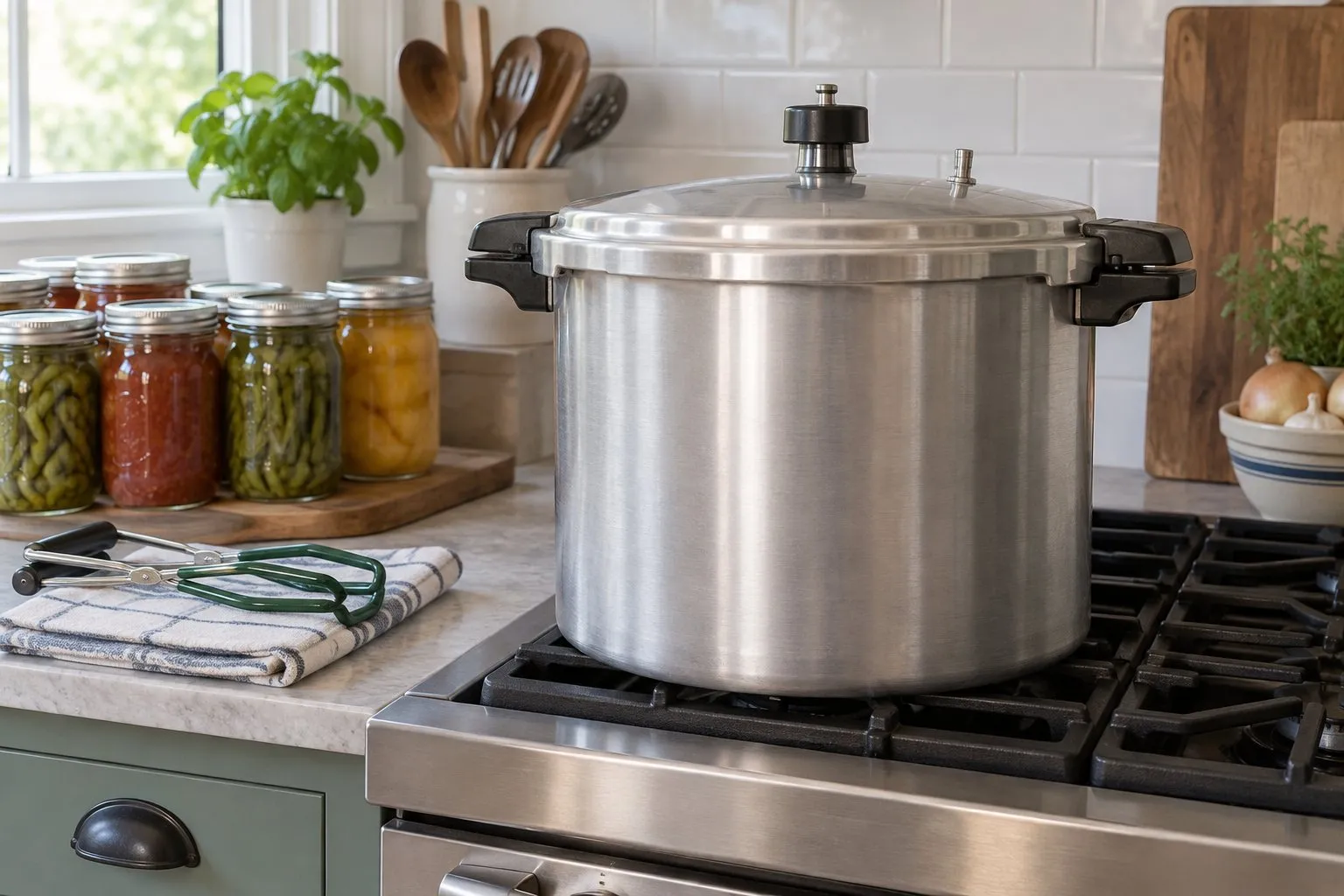
This choice sounds technical, but it is quite friendly. It comes down to whether you would rather listen or look, and how high up you live. Neither gauge makes your jars safe by itself. A gauge helps you follow a tested recipe correctly.
How do they compare?
| Weighted gauge | Dial gauge | Heat sensor (digital canner) | |
|---|---|---|---|
| What you notice | It rocks or jiggles, so you can hear it | A needle on a dial | Lights on a display |
| What it reads | Pressure | Pressure | Heat, says Presto |
| Pressure steps | Fixed settings | Small steps, marked in pounds | You do not set a pressure, says Presto |
| Who controls the heat | You, by the sound | You, by the needle | The machine, says Presto |
| Yearly accuracy check | Not needed unless damaged | Needed | Never, says Presto. We found no outside confirmation |
| At altitude | Fewer steps, so less precise | Finer steps | Presto says no change is needed. Not confirmed outside the company |
| Example | Presto 01745 | Presto 01781 | Presto Precise |
What is each one like to use?
How does it tell you?
The USDA says a weighted gauge lets out tiny bits of air and steam each time it rocks or jiggles. The sound tells you the canner is holding the right pressure. You do not need to stare at it. Penn State says some weight designs can cause steam burns, so handle yours the way the manual says.
A dial gauge shows you the number. Presto describes its dial canners as quiet. You adjust the burner to hold the needle where the recipe asks.
If the pressure drops below the amount you need, the USDA says to bring the canner back to pressure and start timing over from the beginning. That is true for both kinds of gauge. It is a good reason to stay close by.
What about accuracy over the years?
This is the real cost of a dial. The USDA says to check dial gauges before use each year. A gauge that reads too high causes under-processing and may leave food unsafe. The USDA says to replace a gauge that is off by more than 2 pounds.
Have it checked before the season starts. Check sooner if the lid was dropped or went under water, the glass is damaged, or the needle does not rest on zero, says Presto's care sheet. Many county extension offices do this. Dial gauge testing explains where to go.
A weighted gauge skips that routine. The USDA says it needs no accuracy check. Presto's care sheet says to replace the weight only if it is damaged or lost.
What about altitude?
Your altitude may make the choice for you. Presto says its dial canners help above 2,000 feet, where small pressure steps matter. It says its weighted canner suits 1,000 feet or less.
The USDA says the one downside of weighted gauges is that they cannot adjust as precisely at higher altitudes. The National Center for Home Food Preservation's tables use more altitude bands for a dial. We give no pressure table. The altitude page explains this and links to the USDA tables.
Is the weight on a dial canner a weighted gauge?
No. This trips up many new canners. A dial-gauge canner usually has a small weight on it too. On Presto's dial models it is a one-piece regulator. Presto calls it a safety part that stops pressure from building past its limit. Presto's parts sheet says the dial only shows the pressure. It does not control it. You still do that with the burner.
Presto's weighted canner uses a different part: a 3-piece adjustable regulator with removable weights. They look alike and do different jobs. When you order, the USDA says to give your canner's model number and describe the part you need. Pressure canner parts has more.
Switching is possible, says Presto. Its newsletter says most of its dial canners can take its weighted regulator, part 50332, in place of the one-piece regulator. Most older models need conversion kit 85485.
You then go by the rocking of the regulator, not the dial. The altitude cutoffs change to those for a weighted gauge, so the dial chart in your manual no longer applies. That is Presto's word about Presto canners. We found no other source. Ask Presto about your model first.
What about All American canners?
All American canners have both a weight and a dial, which confuses people. NDSU Extension says they are weighted canners with the dial for reference. They rely on the weight for processing, and their dials are not checked every year. Our All American page covers the rest of that brand.
Where does a heat sensor fit?
A digital canner such as the Presto Precise has neither gauge. Presto says it senses heat, holds it automatically and never needs checking.
In principle that goes straight to what matters. The National Center for Home Food Preservation says the heat and how it spreads inside the jars decide whether food is safe. But a sensor in the canner does not measure heat inside your jars. Presto has not published its jar data. Nobody outside the company has published test results for Presto Precise canners.
The digital pressure canner page explains the idea. Plug-in vs. stovetop weighs the trade-off.
How do I choose?
Take the dial if you live above 1,000 feet, or like to see the number and do not mind one yearly errand. Take the weighted gauge if you live lower down and would rather listen than watch.
Either way, your next stop is the tested recipes page and your canner's manual.
Presto
Presto 23-Quart Stovetop (01781)
A pot for your stove, the kind the USDA's canning steps were written for.
- Type
- Stovetop pressure canner with dial gauge
- Pressure canning
- Yes
- Water bath
- Yes, quarts and smaller, per Presto
- Liquid capacity
- 23 quarts
- Jars per load
- 7 quarts, or 20 regular-mouth pints stacked
- Altitude
- You raise the pressure by altitude from the USDA tables. Water bath times also change with altitude.
- Price class
- Mid-range
Stated in: Presto Canner Comparison Guide (2025), read 2 November 2026
Why here: Our pick for most readers: a dial gauge that allows small pressure steps at altitude, and 7 quart jars, says Presto. Plan for its accuracy check every year.
Best for: You want to pressure can low-acid foods (vegetables, meat, chicken, fish) and can stay near the stove.
- The National Center's advice was written for stovetop canners
- Seven quart jars, or up to 20 regular-mouth pints stacked, says Presto
- Also works as a water bath canner for quarts and smaller, says Presto
- Works on gas and on electric coil and smooth-top ranges, says Presto
- You watch the gauge and adjust the heat yourself
- The dial gauge needs an accuracy test every year, says Presto
- Presto does not list induction for this pot. The 01784 is its induction version
Which one, then?
If you live above 1,000 feet or want to see small changes → Presto 23-Quart Stovetop (01781)
View(paid link to Amazon, opens in a new tab)Ad · paid link · check price & delivery on AmazonIf you would rather hear the pressure and not watch a needle
If you want neither gauge and accept the open questions
If you are comparing every stovetop option
What people ask
Which is better, a weighted gauge or a dial gauge?
Neither by default. Penn State Extension says both work equally well when used correctly. The USDA says the one downside of a weighted gauge is that it cannot adjust as precisely at higher altitudes. A dial must be checked for accuracy each year. So your altitude and how you feel about a yearly check decide.
Does a weighted gauge need testing?
The USDA says weighted gauges need no watching during processing and no accuracy check. Penn State adds that yearly testing is not needed unless the weight is damaged. Keep the vent clear. Read your manual on how your weight should behave at pressure, since NDSU notes that weights come in different styles.
Where can I get a dial gauge checked?
The USDA and CDC say many county university extension offices (free local food-safety advice) will check gauges. You can also ask the canner's maker. Presto's care sheet describes sending a gauge to its consumer service. Presto's testing unit covers only dial gauges for Presto, National, Magic Seal and Maid of Honor canners. Call ahead with your brand.
Can I use a weight on my dial-gauge canner to skip the dial?
Not with the weight it came with. On Presto's dial models, the one-piece regulator is a safety part, and the dial shows your processing pressure. Presto's newsletter says most of its dial canners can switch to its weighted regulator, part 50332. Most older models need kit 85485. The altitude cutoffs then change. Ask Presto first.
What does the dial on an All American do?
NDSU Extension says All American canners are weighted canners with a dial gauge for reference. They rely on the weight for processing, and their dials are not checked every year. Your manual and the maker are the place to check anything about that model.
Where this comes from
- USDA Complete Guide to Home Canning, revised 2015, Guide 1
- Penn State Extension: Buying a pressure canner (April 21, 2026)
- NDSU Extension: Pressure Can It Right! FN2064 (revised August 2026)
- Presto: Canner Comparison Guide (2025)
- Presto: Parts of a typical pressure canner (2022)
- Presto: Let's Preserve Together newsletter, issue 2 (July 2024)
- NCHFP: Canning in electric multi-cookers (February 1, 2019)
More from the shelf
- Buying guideStovetop cannersA stovetop pressure canner is the type the canning experts wrote their advice for. See dial vs weighted gauge, jar counts, stove fit and our pick.
- ExplainerAltitudeHigh altitude canning depends on your machine: USDA tables for stovetop canners, Presto's sensor claim, NESCO's regulators and water bath changes.
- ExplainerDigital cannersA digital pressure canner runs on a temperature sensor instead of a gauge. How it works per Presto, what changes for you, and what it can't show about your jars.
- BrandPresto stovetopPresto's stovetop pressure canners: the 01781, 01755, 01784 and 01745 compared by size, gauge and stove fit, plus what to know about small and old pots.
- BrandAll AmericanAll American pressure canners seal metal to metal, with no gasket. See all six sizes from 910 to 941, jar counts per the maker, glass-top limits and care.
Who writes here
electricpressurecanner.com Editorial Team
Machine comparisons & source reading
We are the editorial team at electricpressurecanner.com. We read manuals, spec sheets and the statements of NCHFP, USDA, CDC and Extension services, and we report who says what, with dates. No lab work happens here, and this site publishes no processing times or recipes of its own.
- Manuals and food-safety guidance read
- Sources and dates on every page
- No lab tests, stated openly
- No own processing times or recipes