Buying guide
Canning Lids and Jars for Pressure Canning: Regular or Wide Mouth?
Buy Mason-type home-canning jars and new two-piece lids in the same mouth size. The USDA says jars can be reused many times and only need new lids each time. Regular or wide mouth also changes how many jars fit. On Presto's 16-quart digital chart it is 10 regular-mouth pints or 8 wide-mouth. The NESCO NPC-9 takes wide-mouth quarts only.
Disclosure: This page contains affiliate links (marked with *). If you buy through them, we earn a small commission at no extra cost to you. As an Amazon Associate I earn from qualifying purchases. Learn more
The short answer
For pressure canning, use Mason-type home-canning jars and new flat lids with screw bands. The USDA says mayonnaise-type jars are not recommended for pressure canning. Flat lids are for one use. Bands can be reused while in good shape. Presto's jar charts change with mouth size. We know the products below only from Amazon listings, so we name none as our pick.
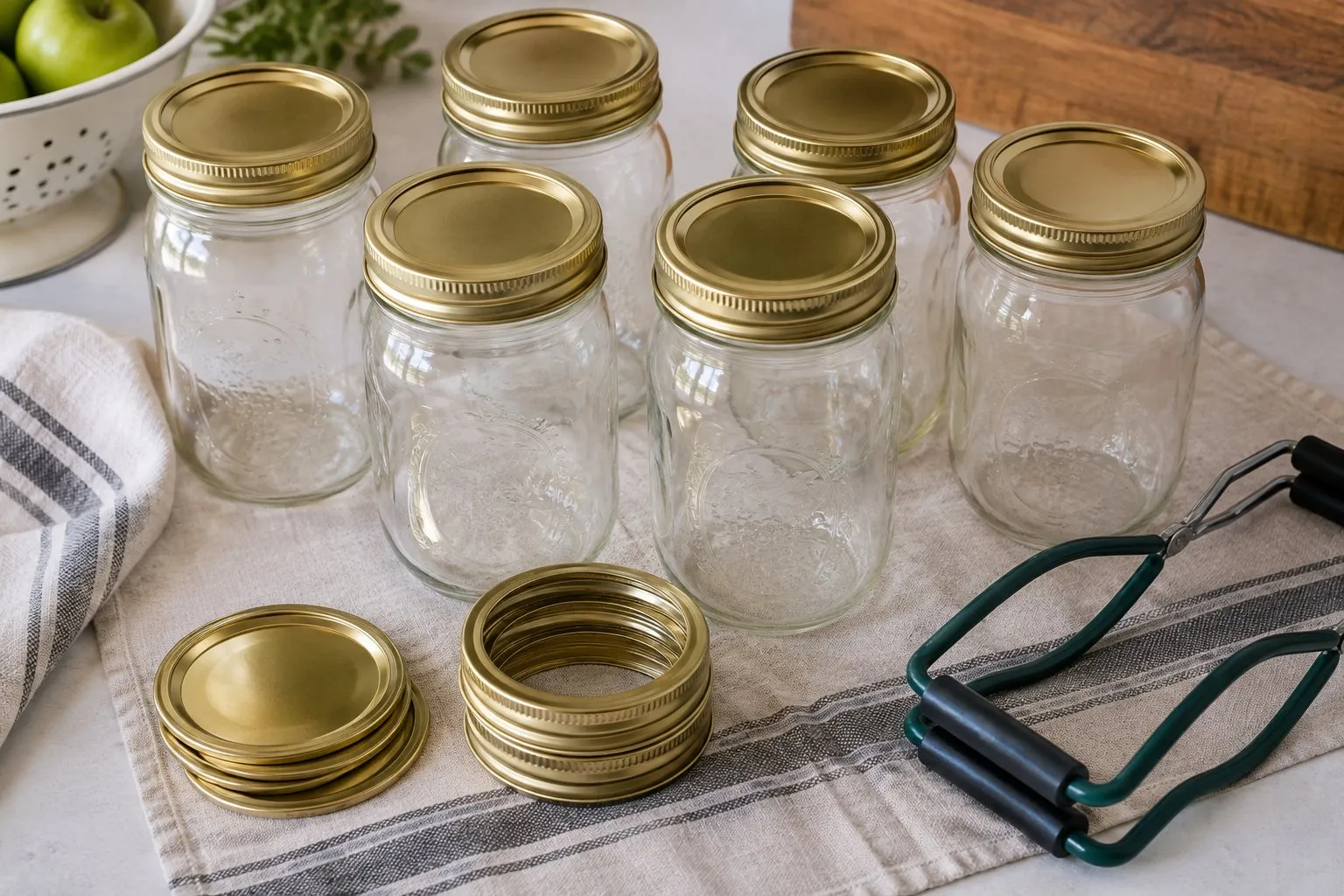
A fresh box of lids at the start of the season is very satisfying. Here is how to buy the right ones without overbuying, and how to pick jars that suit your canner.
What do you recommend?
Choose Mason-type home-canning jars, new flat lids and screw bands in one mouth size. Let your canner's chart and the jars you already own decide the mouth size. Buy only as many lids as you will use in a year. Dry-fit your jars in the canner before you fill anything.
We do not name one brand as our pick. We could not read Ball's own lid and jar pages, because the site refused our requests. We hold no maker's documents for the other listings. So the products below are options we know only from their Amazon listings. We say what we know and leave it there.
Start from what you have
If you have a plug-in canner or plan to buy one
If you have a stovetop canner or plan to buy one
If you need the funnel, lifter and the rest of the kit too
What are the options?
Ball
Ball Regular Mouth Lids
Flat lids for regular-mouth Mason jars, 96 in all, says the seller's listing title.
Seller data only
Best for: You use regular-mouth jars and have checked that the pack size suits how many lids you will use in a year.
FORJARS
FORJARS Regular Mouth Lids
A 100-pack of regular-mouth canning lids, known to us only from its Amazon listing.
Seller data only
Best for: You use regular-mouth jars and accept that we read no maker's document for these lids.
FORJARS
FORJARS Wide Mouth Lids
A 100-pack of wide-mouth canning lids, known to us only from its Amazon listing.
Seller data only
Best for: You use wide-mouth jars and accept that we read no maker's document for these lids.
Ball
Ball Regular Mouth Pint Jars
Regular-mouth pint Mason jars in an 8-count box, says the seller's listing title.
Seller data only
Best for: You want regular-mouth pints, the size with the higher count on Presto's 16-quart digital chart.
Listing without a known maker
12-pack wide-mouth quart jars
A 12-pack of wide-mouth quart jars with lids, known to us only from its Amazon listing.
Seller data only
Best for: Only after you have checked the listing for a maker's word on home canning and two-piece lids.
Ball regular-mouth lids. The listing title describes 8 boxes of 12, so 96 lids in all. That is a lot for one household, given the USDA's advice to buy a year's worth. Check that the count suits you.
FORJARS lids, regular and wide. The listing titles describe 100-packs. Penn State reports that off-brand lids may seal. It says some people report more seal failures. It also says fake lids sold as major brands have been reported online. It names no brand, so that is not a statement about these lids. If you try any lid that is new to you, follow its maker's directions. Check the sealant and disk before use.
Ball regular-mouth pint jars. An 8-count box of 16-ounce regular-mouth jars, says the seller.
12-pack of wide-mouth quart jars. The title mentions fermenting, pickling and meal prep as well as canning. We found no statement from the maker. Penn State says it does not know the quality of several new, often imported, jar brands. It names none. Check the listing carefully before you buy for pressure canning.
How does mouth size change what fits?
Most shopping pages skip this. Jars do not stack the same way in every pot. These counts are what each maker says.
| Machine | Quarts, regular / wide | Pints, regular / wide |
|---|---|---|
| Presto 12-quart digital | 5 / 5 (see the note on our sizes page) | 8 / 7 |
| Presto 17-quart digital | 5 / 5 | 8 / 13 stacked |
| Presto 16-quart digital | 7 / 7 | 10 / 8 |
| Presto 23-quart digital | 7 / 7 | 20 / 16, both stacked |
| NESCO NPC-9 | Wide-mouth only, up to 4 | Up to 5, mouth size not stated |
The NESCO is a combination cooker and canner, and there is a caution about those. Read what the experts say about plug-in canners before you weigh it. These counts are about room only. They say nothing about safety. Our plug-in canner sizes page has half-pints and water bath too. Pressure canner sizes covers stovetop pots.
Two things follow.
- Mouth size can move your count either way. Wide-mouth pints cost you a jar or two on the 12-quart and 16-quart. On the 17-quart they go the other way and reach 13 when stacked, says Presto.
- Mason jars are not all the same width. Presto says width can vary from one maker to another. It asks you to test-fit the canner first. NESCO asks you to dry-fit your jars. Do it with empty jars on the rack.
Which jars should I buy?
The USDA says regular and wide-mouth Mason-type home-canning jars with threaded necks and self-sealing lids are the best choice. They come in half-pint, pint, pint-and-a-half, quart and half-gallon sizes.
- Stick to what recipes use. Penn State says directions are based mainly on pints and quarts for fruits and vegetables, and half-pints for jelly. Your tested recipe names the jar. Presto says never to use a larger jar than the recipe lists.
- Half-gallons are a special case. The USDA says they may be used for very acid juices. Penn State names apple and grape juice. One-gallon jars are not recommended for food preservation, says Penn State.
- Skip the tulip shape. Penn State says tulip-shaped jars are not recommended, because the wider part heats more slowly.
- Used jars are fine if you look closely. The USDA says Mason jars may be reused many times with careful handling. Penn State says to check for nicks, cracks and tiny stress lines. It says to treat jars from the 1920s to 1970s as antiques for decoration, not canning.
- Avoid store-bought jars. The USDA says mayonnaise-type jars are not recommended for pressure canning because they break too often.
Which lids and bands should I buy?
The USDA describes the common self-sealing lid as a flat metal lid held down by a screw band during processing. A sealing compound softens and forms a seal as the jar cools.
- Use a new flat lid each time. Presto says flat lids are for one use only. Penn State says the sealant is only reliable for one seal.
- Bands can be reused. Presto says to skip dented or rusty ones. The USDA says to take bands off stored jars once cool, because bands left on can rust and stick.
- Follow your lid's instructions on preparation. The USDA and Presto both send you to the lid maker's directions. That box is your source, so we do not repeat it here.
- Do not overbuy. The USDA says to buy only as many lids as you will use within a year. It says the seal ring in unused lids works well for at least 5 years from the date made.
- Do not tighten again after processing. The USDA and Presto both say so. Fingertip tight going in, then leave them alone.
What about reusable lids?
Penn State describes three-piece reusable lids: a plastic or glass disk with a rubber or silicone ring, and a band. They cost more than two-piece lids. Penn State says they can be used for pressure canning if the canner's inside heat does not go over 250°F. You check the seal by taking off the band and lifting the disk.
Presto's manual names the two-piece cap as the recommended closure. If you are curious, read the lid maker's directions and your canner's manual side by side.
What mistakes should I avoid?
- Reusing a flat lid because it looks fine. See above.
- Buying jars before checking the chart. Your machine's count depends on the mouth size.
- Mixing mouth sizes in the box. A regular-mouth lid will not fit a wide-mouth jar, so count both.
- Reading a good seal as proof. A seal does not show that the food got hot enough. Our botulism page explains why. Jars not sealing covers lids that fail.
What should I do next?
Match the mouth size, check your machine's chart, buy what you will use in a year, and follow a tested recipe. The rest of your kit is on our canning tools page. How we compare explains why a maker's document counts for more than a listing. If you are still choosing the canner, our overview of all machines is a good next stop.
What people ask
Can canning lids be reused?
Flat metal lids should not be reused for canning. The USDA says Mason jars only need new lids each time. Presto says the flat lid is for one use only, while bands can be reused in good shape. Penn State says the sealant is only reliable for one seal.
Are wide-mouth lids different from regular-mouth lids?
Yes, and they do not swap. The USDA gives a standard opening of about 2-3/8 inches and a wide-mouth opening of about 3 inches, which is easier to fill and empty. Buy lids to match your jars. Wide-mouth jars also change how many fit in a canner, so check your machine's chart.
Do canning lids expire?
The USDA says the seal ring in unused lids works well for at least 5 years from the date made. Older unused lids may fail to seal. It says to buy only as many lids as you will use within a year. Do not use lids that are old, dented or misshapen, or that have gaps in the seal ring.
Are reusable canning lids OK for pressure canning?
Penn State says three-piece reusable lids can be used in a pressure canner if its inside heat does not go over 250°F. It says to check the seal by taking off the band and lifting the disk. We read no USDA process written for them. Follow the lid maker's directions and your canner's manual.
Can I use old mayonnaise or pasta sauce jars?
Not in a pressure canner. The USDA says mayonnaise-type jars are not recommended for pressure canning because they break too often. Store-bought jars that cannot take two-piece lids are not recommended for home canning of any food. Penn State adds that twist-off lids from pickle or sauce jars should not be used.
Where this comes from
- NCHFP: Recommended jars and lids (from USDA Complete Guide, revised 2015)
- USDA Complete Guide to Home Canning, revised 2015, Guide 1
- Penn State Extension: Canning jars and lids, an update (February 18, 2025)
- Presto: 02153 and 02154 instructions, Form 4124-204D
- Presto: Precise Digital Pressure Canners, Facts and FAQ (2025)
- NESCO: NPC-9 Care/Use Guide (2026 revision)
More from the shelf
- Buying guideCanning toolsThe canning supplies the USDA's steps actually name, the extras that make the job nicer, and what to skip. Includes our pick for a tool set.
- CompatibilityElectric canner sizesWe found no 10-quart electric pressure canner made just for canning. Here are the jar counts for each size and method, from the makers' own charts.
- CompatibilityPressure canner sizes16 or 23 quart pressure canner? Both hold 7 quart jars, says Presto. See what the taller pot adds, the four-jar minimum, and the largest sizes.
- How-toHow to use a cannerHow to use a pressure canner on the stove: checking, loading, letting air out, holding pressure and cooling. Figures are left to your recipe.
- About this siteHow we compareHow this site compares plug-in canners: we read manuals and expert advice, run no lab tests, give no processing times, and say when sources disagree.
Who writes here
electricpressurecanner.com Editorial Team
Machine comparisons & source reading
We are the editorial team at electricpressurecanner.com. We read manuals, spec sheets and the statements of NCHFP, USDA, CDC and Extension services, and we report who says what, with dates. No lab work happens here, and this site publishes no processing times or recipes of its own.
- Manuals and food-safety guidance read
- Sources and dates on every page
- No lab tests, stated openly
- No own processing times or recipes