Explainer
What Is a Pressure Canner? A Plain Explanation
What is a pressure canner? It's a large pot with a locking lid, a vent and a gauge. It traps steam, so the jars inside get hotter than boiling water can. The USDA says low-acid foods (vegetables, meat, chicken, fish) should be heated to 240° to 250°F, which pressure canners reach. It says those foods must be canned in a pressure canner to be free of botulism risks.
Disclosure: This page contains affiliate links (marked with *). If you buy through them, we earn a small commission at no extra cost to you. As an Amazon Associate I earn from qualifying purchases. Learn more
The short answer
A pressure canner is a large pot that traps steam so jars reach temperatures boiling water can't. The USDA lists these parts: a jar rack, a gasket, a dial or weighted gauge, a vent and cover lock, a vent port and a safety fuse. For USDA instructions, Penn State says it must hold four quart jars upright with the lid on, let air out, and show it stays at pressure.
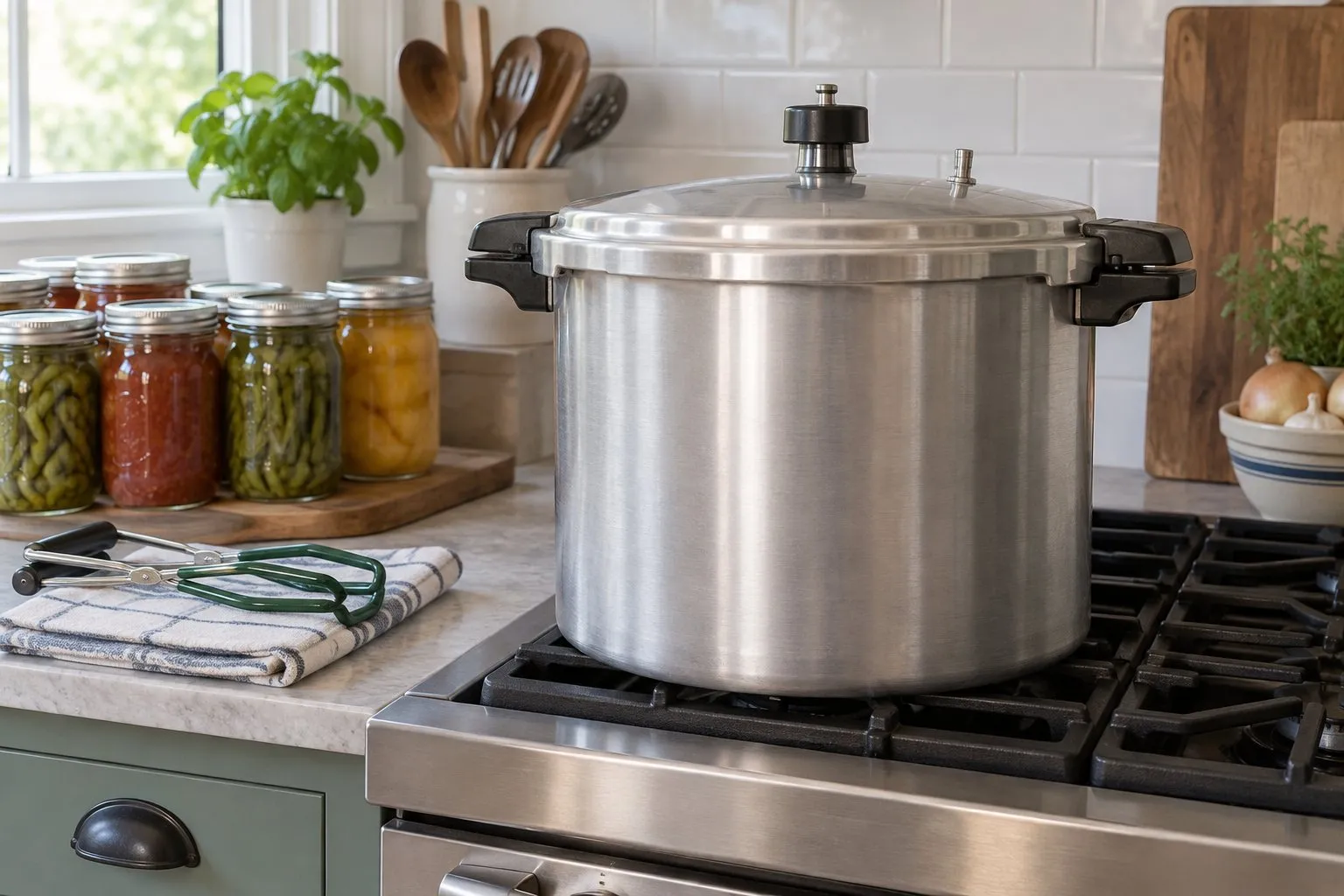
If the word "pressure" makes this equipment sound a bit scary, you're in good company. Once you know what the pot is doing, and why, it's a lot less mysterious.
What does it do?
Water in an open pot stops getting hotter once it boils. A pressure canner locks steam in, and that lets the inside get well above boiling. The USDA is careful about why this matters: pressure doesn't kill germs, but high heat held long enough does.
So pressure is a means to an end. Heat does the work. That's why the method exists: the spores behind botulism are hard to kill at boiling temperature. Our botulism page explains.
The USDA names two things that can spoil the math. They explain much of what you do with a canner:
- Altitude. Temperatures inside a canner are lower at higher altitudes, so canners must run at higher pressure for your altitude range. Our altitude page explains and links to the official tables.
- Trapped air. Air left in the canner lowers the temperature at a given pressure and leads to under-heating. So the USDA says all types of pressure canners must have the air let out before they're pressurized.
What are the parts for?
The USDA describes today's home pressure canners as lightweight, thin-walled kettles, most with turn-on lids. You'll find these parts:
- Jar rack: holds jars off the bottom of the pot (Presto).
- Gasket or sealing ring: makes a pressure-tight seal between lid and pot (Presto). At least one style seals with the metal surfaces touching instead, says University of Georgia Extension.
- Dial or weighted gauge: shows the pressure. A weighted gauge also controls it (USDA, University of Georgia Extension).
- Vent pipe or vent port: lets air and steam out before pressurizing, and lets excess pressure out (USDA, Presto).
- Vent and cover lock: keeps the lid from opening while there is pressure inside (USDA, Presto).
- Safety fuse or overpressure plug: lets excess pressure out if the vent pipe clogs (USDA, Presto).
Our gauge comparison sorts out the two kinds of gauge. The USDA also says to use only canners with Underwriter's Laboratory (UL) approval. University of Georgia Extension adds that the mark may appear only in the manual. That is an electrical and product safety mark. It says nothing about food.
What makes it a pressure canner, not just a big pot?
Listings use the name loosely, so it helps to know the test. For USDA instructions, Penn State says a pot must do three things:
- Hold at least four quart jars upright with the lid on.
- Let air out while it comes up to pressure.
- Have a dial or weighted gauge, so you can confirm it stays at the right pressure the whole time.
The National Center for Home Food Preservation (the US canning experts at the University of Georgia, "the National Center" from here on) explains why a small pot falls short even if it builds pressure. The heat from coming up to pressure and cooling down counts toward the total. Small cookers go through both too quickly. The canner vs. cooker page compares them.
Holding four quart jars is one condition among several. It doesn't prove the heat-up, hold and cool-down match the tested process. Temperature decides.
What do you use one for?
Low-acid foods have a pH above 4.6. They include red meat, seafood, chicken, milk and all fresh vegetables except most tomatoes. The USDA says they must be canned in a pressure canner. The CDC says pressure canning is the only recommended method, and a boiling water canner does not protect against botulism in these foods.
The steps come from your tested recipe and your machine's manual. We publish no times, pressures or water amounts. The tested recipes page shows where to find them. Your canner's manual speaks for your exact model. How to use a pressure canner gives the order of the steps.
Are plug-in machines the same?
No. The description above is of a stovetop pot, the type the National Center says its instructions were written for. Plug-in machines get lumped in with it, and they shouldn't.
- Plug-in canner made just for canning. It is an appliance sold for pressure canning jars of food, with its own heating element and automatic controls. It's not the same as an electric pressure cooker or an electric water bath canner. Neither the USDA nor the National Center certifies or approves any canner.
- Cooker-canner combo. Penn State says these can't be recommended because research on their safety is missing. It names no brand. Putting the NESCO NPC-9 in that group is our own reading. Are electric pressure canners safe reports who says what.
- Electric multi-cooker. The National Center does not support USDA canning instructions in them, even with canning buttons. The CDC says not to use them for canning low-acid food.
A statement about one of these doesn't carry over to the others. Our guide to machine types puts them side by side.
What about an old canner?
The USDA says canners made before the 1970s were heavy-walled kettles with clamp-on or turn-on lids. University of Georgia Extension says old or possibly unsafe canners should not be used. It says to make sure an old pot really is a pressure canner and not an old sterilizer or steamer, and to inspect all parts first.
Where to go from here
Our stovetop canner guide compares the options. This is the pot we'd start with:
Presto
Presto 23-Quart Stovetop (01781)
A pot for your stove, the kind the USDA's canning steps were written for.
- Type
- Stovetop pressure canner with dial gauge
- Pressure canning
- Yes
- Water bath
- Yes, quarts and smaller, per Presto
- Liquid capacity
- 23 quarts
- Jars per load
- 7 quarts, or 20 regular-mouth pints stacked
- Altitude
- You raise the pressure by altitude from the USDA tables. Water bath times also change with altitude.
- Price class
- Mid-range
Stated in: Presto Canner Comparison Guide (2025), read 2 November 2026
Why here: A stovetop pot with a dial gauge and a documented jar chart, in the type the National Center says its instructions were written for.
Best for: You want to pressure can low-acid foods (vegetables, meat, chicken, fish) and can stay near the stove.
- The National Center's advice was written for stovetop canners
- Seven quart jars, or up to 20 regular-mouth pints stacked, says Presto
- Also works as a water bath canner for quarts and smaller, says Presto
- Works on gas and on electric coil and smooth-top ranges, says Presto
- You watch the gauge and adjust the heat yourself
- The dial gauge needs an accuracy test every year, says Presto
- Presto does not list induction for this pot. The 01784 is its induction version
If a word here was new to you, the glossary has short explanations. Learning what the pot does before you buy one is a very good place to begin.
What people ask
What is pressure canning?
It means heating filled, lidded jars in a sealed pot of steam for the time and pressure a tested process gives. The USDA says pressure doesn't kill germs. High heat held long enough does. The pressure is just what lets the steam get that hot.
What is a canning pressure cooker?
Mostly a shop term. Some large pots are sold as both, such as the Presto 01781, which Presto calls a pressure canner and cooker. The name doesn't decide it. Penn State says the pot must hold four quart jars upright with the lid on, let air out, and have a dial or weighted gauge.
Is a pressure canner the same as an electric pressure canner?
No. An electric pressure canner is a plug-in appliance sold for pressure canning jars of food, with its own heating element and automatic controls. The National Center for Home Food Preservation says its instructions were written for stovetop canners. Nobody outside the company has published test results for Presto Precise canners.
Do I need a pressure canner for everything I can?
No. The CDC says pressure canning is the only recommended method for low-acid foods. The USDA says a pressure canner may also be used for high-acid foods (jam, most fruit, pickles), but recommends boiling water canners because they're faster. Your tested recipe names the method for that food.
Where this comes from
- USDA Complete Guide to Home Canning, revised 2015, Guide 1 (page 1-19)
- NCHFP / UGA Extension: Preserving Food, Using Pressure Canners (June 2025)
- Penn State Extension: Pressure canner updates (September 13, 2024)
- NCHFP: Canning in pressure cookers (September 2015)
- Presto: Parts of a typical pressure canner (2022)
- CDC: Home-canned foods and botulism (April 25, 2024)
More from the shelf
- Buying guideStovetop cannersA stovetop pressure canner is the type the canning experts wrote their advice for. See dial vs weighted gauge, jar counts, stove fit and our pick.
- ComparisonCanner vs. cookerA pressure canner holds four or more quart jars, vents air, and shows it holds pressure. Why a cooker is not the same, and what USDA instructions cover.
- GlossaryGlossaryCommon home canning and pressure canner words explained in a sentence or two, with where each explanation comes from. Sorted A to Z, with no recipes.
- ComparisonWeighted vs dial gaugeA weighted gauge rocks and needs no yearly check. A dial reads in small steps and does need one. A sensor reads heat. Here is how to choose.
- How-toHow to use a cannerHow to use a pressure canner on the stove: checking, loading, letting air out, holding pressure and cooling. Figures are left to your recipe.
Who writes here
electricpressurecanner.com Editorial Team
Machine comparisons & source reading
We are the editorial team at electricpressurecanner.com. We read manuals, spec sheets and the statements of NCHFP, USDA, CDC and Extension services, and we report who says what, with dates. No lab work happens here, and this site publishes no processing times or recipes of its own.
- Manuals and food-safety guidance read
- Sources and dates on every page
- No lab tests, stated openly
- No own processing times or recipes